
Keilmuan
THE REAL ALIEN INVASION
This language version was translated automatically and has not been reviewed by a human yet.
The alien invasion has already claimed many victims and destroyed the natural order of nature and humanity. We must act immediately, fight against them because we are human. From which planet do these aliens come? Since when have they arrived? What are these aliens like? And what can we do if bullets cannot kill them?
Hello comrade/sister/brother Commander – VIVA DIAZ !!!
In this article, we will discuss the issue of Indonesia's natural ecosystem which over time may sound increasingly sad to realize. Not about waste, pollution or massive damage that comes as a result of modern technology, but something that perhaps few people and even we ourselves realize. Alien invasion..., "you are not misreading" we will discuss aliens that damage the order of natural and human life. But, what are these aliens like? When did they come? From which planet do they originate? and what can we do? we will cover all of this in an article that may be somewhat lengthy. You could say it can be reading material for you when you are traveling by public transportation or just filling other spare time. This article is written based on the personal concerns of the author and aims to educate the wider Indonesian public.
It should be noted that this article would not run smoothly without assistance from various parties. The author extends gratitude to:
General Chairman of OPA DIAZ Redy Apriyadi – D. 139140 Elang Borneo
All Members of the OPA DIAZ Board
Yoga Ahmad Alauddin – D. 139.2024.33.12 Elang Bondol
Muhammad Fauzi - D. 139176 Elang Bondol
The Entire OPA DIAZ Family
As well as all parties who assisted in writing this article whose names cannot be mentioned one by one.
CHAPTER I – PROLOGUE
ALIEN?
Perhaps what comes to mind when we mention "alien invasion" is the arrival of spaceships from the sky that are able to travel interstellar distances at the speed of light around 300,000 km/s. Then they descend from those ships carrying foreign weapons that are far more advanced and begin to massacre the inhabitants of Earth. At that moment, humanity facing the threat of extinction begins to raise weapons to maintain at least its population. Although we will know, there is no weapon of ours that is powerful enough to kill them, not even the legendary AK-47. At those critical moments, there is no longer any talk of defending the nation, nationalism or ideology such as fascism, communism and but humans are struggling to maintain their "species" so it does not become extinct.
Of course, to imagine that this will happen to humans and to Earth, it is still too fantastical and imaginative. However, in reality, without our realizing it, alien invasion has been taking place even around us. Without the sound of AK-47 gunfire, M-16, mortars, grenades, or advanced weapons hidden by the CIA, the invasion has already claimed many victims. Even among those who are victims right now are crying out in despair waiting for extinction or perhaps have accepted themselves if there will not come a female or male that can be invited to continue the next generation because they are the only one left on this vast Earth.
"So, what is this alien like?"
What is it like? Is it a creature with tentacles and slime all over its body with strange reproduction patterns? Or is it a humanoid entity with an elongated head, large eyes and green-colored skin that descends with its flying saucer? Or even more terrifying, do they disguise themselves as Earth creatures and are hidden by global elites or secret government organizations like Men in Black?
The answer is "of course not", implicitly perhaps yes, but technically the alien I mean here is not like that. In the world of biology, alien or "alien species" has a meaning more towards "newcomer". A creature or species from a region in one part of the Earth that then comes and settles in a region or another (new) part of the Earth is called an alien species. Simply put, they are like white people who sailed to the American continent and then settled there and interacted with the local Native American population.
INVASION
Perhaps lately if you like discussions closely related to the environment, you have often heard the word "invasive". In human history, invasion is carried out by one nation or people against another nation. The objectives vary greatly, some conduct invasions to gain legitimacy of power, some also aim to colonize and build wealth in their home country, some also intend to make a nation a kind of protective fortress to prevent invasion from other enemy nations like Russia-Ukraine currently, and many more. However, the definition of invasion according to me is divided into 2 key words, namely, Come and Control and then from the word "control" arises the impact.
Similarly, as is the main discussion of us in this article. Foreign species come from one region then control a new region so that it has an impact on local life. The cause is almost always initiated by the species said to be the wisest, namely humans (Homo sapiens). After the alien arrives, the new place is very different from its native land, previously they had predators that always threatened, or previously in terms of food they competed with other species, but in the new place the environment does not give them the opportunity to face challenges.
To make it easier, just imagine it like this:
You with your own sweat built a house from scratch, every month you saved to build a house project that was good and according to your wishes. When the house was finished, you were very happy living there, complete furniture, a peaceful environment and all the comforts in it. Until one day, someone you know comes and asks permission to stay because of something, and you allow it because of pity. Then the longer he stays, he doesn't immediately look for a new place to live, he stays at your house and begins to be lulled by its comfort. Even longer, he starts to be ungrateful, you see the refrigerator that is empty because your friend ate from it, you see the house that is starting to become messy with food scraps everywhere. The house that you originally built, is no longer exclusively yours, the rules that you made yourself begin to break down while your friend who is staying becomes the rule. Pretty annoying isn't it?
But before going too far, we should first understand these 2 terms, namely local/native species and endemic species. Local/native species are species that naturally live in a certain area and have contributed to the continuation of the ecosystem for a very long time. While endemic species are species that only exist or live in one area on earth and are not found in other areas. Simply put, endemic species are local species, but local species are not always endemic species.
Indonesia has many endemic species, Jalak Bali in Bali, Komodo in NTT, Cendrawasih in Papua and many more. They are the original inhabitants of their territory which are very vulnerable given their numbers which are almost always limited due to adaptation to their quite complex environment. The arrival of invasive aliens could threaten their populations, creating new food competitors or even new predators and this has happened many times. So, perhaps if I use the analogy above, endemic or native species will have the fate like you the rightful owner of that house or even worse.
"Invasive species act as nature's scavengers, neutralizing the forces that they should promote (when native ecosystems are disrupted)"
-Fred Pearche-
CHAPTER II – HOW ALIENS BECOME INVASIVE
There are many ways about how a species can come to another place or region and then become invasive, but as mentioned before, humans are the main factor. How not, humans themselves are the most "invasive" creatures on earth. We discussed it in another article on this website titled Kisah Para Elang : Penguasa Langit Kuno where some ancient eagles are increasingly disappearing from the sky after migration or the arrival of humans in the area where the eagle lives. Haliaeetus sp. for example, that ancient eagle is increasingly invisible as human activity increases.
However, about how a creature can come and become invasive in an area has basically been discussed by scientists for a long time. One figure who discussed it was Charles Darwin in his controversial book On the Origin of Species. Darwin once discussed how a creature could move and potentially dominate if there were no natural competitors. He argued:
"Lack of competitive exclusion would facilitate the establishment of alien invaders phylogenetically distinct from the native flora"
"The lack of competitive exclusion will facilitate the formation of invasive alien species (alien) that are phylogenetically different from native flora"
Let us take an example from an old case, the invasion of black rats. Black rats during the era of sea exploration by European nations in the 17th century hitched a ride and sailed together with merchant ships. They could enter the ship probably because they were attracted to the food supplies brought by the sailors. The merchant ships sailed until they reached continents, mainland and new islands. Every time a ship docked at a new mainland, black rats could get off the ship and settle there. The conditions of the new environment that felt more comfortable than the previous environment triggered them to reproduce faster. As a result, their population exploded, spreading diseases that were unknown to local residents and killing many lives, destroying agricultural products and dominating the local ecosystem. That dominance in the ecosystem will displace local species and suppress the population of endemic species.
According to IUCN (International Union for Conservation of Nature), invasive alien species or invasive alien species (IAS) move or enter new areas outside their natural range mainly through human activities, either intentionally (Intentional) or unintentionally (Unintentional). This mechanism or route of movement is known as Introduction Pathways or Introduction Pathways. Based on IUCN guidelines and databases (including the Global Invasive Species Database), here are the main ways how invasive species can move:
INTENTIONAL INTRODUCTION
The first is intentional introduction, which occurs when humans deliberately transfer or bring a species from one part of the world to another, but it then escapes from control and becomes invasive. Humans do this for various purposes mentioned by IUCN, one of which is as ornamental plants or animals because they are considered exotic. This is like Amphilophus labiatus or what is also commonly called the Red Devil Fish which was brought to Indonesia for ornamental fish purposes, but escaped and its population exploded in the wild. Another example is Pomacea canaliculata or Golden Apple Snail which began to be brought to Southeast Asia for food security purposes and many more.
UNINTENTIONAL INTRODUCTION
The second is unintentional introduction, which occurs when a species relocates as a stowaway or contaminant due to high mobility of transportation, free trade, and global tourism. This method of relocation is often mentioned as more terrifying because its spread is frequently undetected and we only become aware of it when the population has already exploded. IUCN also mentions there are several ways, one of which is as previously discussed regarding the spread of Black Rats from the European Continent. Another example is through ship ballast water, or when large cargo ships suck in water at the port of origin to balance the load and then discharge it at the destination port. Microorganisms, fish larvae and shellfish that are small in size or even microscopic in scale then relocate across oceans and subsequently cause problems to local ecosystems.
AMPLIFYING FACTORS
From the 2 factors or methods above, the relocation method is also often supported by an amplifying factor namely "global climate change". IUCN states that global climate change also facilitates these alien species to establish and spread more rapidly. Rising earth temperatures open up new regions that were previously too cold for these alien species to become new habitats that are favorable for them to reproduce massively.
CHAPTER III – ALIEN INVASION IN INDONESIA
WATER SCAVENGER ARMORED – PLECOS
Plecos - Source: detik.com
Plecos or glass cleaner fish or often also called "pleco" is a freshwater fish that began to enter Indonesia since the 1970s through the ornamental fish trade route from South America. This fish then escaped into the wild waters of Indonesia and its population then exploded uncontrollably. This fish is one of the most destructive alien fish species to local ecosystems in Indonesia.
How could it not be, plecos have a unique and extraordinary ability that supports them to become an invasive creature. Plecos are opportunistic omnivores or simply put, they are not picky eaters or "anyi-anyi" (in Javanese). Almost everything is eaten, ranging from algae, moss, aquatic plants and aquatic microorganisms that are also eaten by local species, carcasses, organic detritus (remains of rotten organic matter and sediment at the bottom), to eggs of local fish species themselves. Similarly with its characteristics, male plecos become very territorial in guarding their eggs by being aggressive to anything that approaches even their own females. Besides that, this alien fish is also a hardy fish, not just in the sense of being beaten and still alive, "well yes that's true" because its skin is hard like the armor of a European knight, but what I mean is, it can also live in environments with extreme pollution levels.
It doesn't stop there, this extraordinary adaptation is also demonstrated by this fish being able to live without water for up to about 13-30 hours. Perhaps you have seen one of the videos on this YouTube channel (See >>> pleco comes back to life after being given water). In that video, a pleco fish is shown that is already dry, stiff and shows no signs of life at all, then comes back to life and moves again after being given water. This happens because plecos have dual respiration, namely the special ability to breathe without water and unique blood vessels in their intestines that can bind oxygen. From this alone, it seems we could agree that this fish really is like an alien in Hollywood movies.
However, in its native habitat, plecos actually appear to not be "the antagonist". Its unfriendly environment, namely the Amazon River, plecos are not given the opportunity to stop being vigilant. Predators there are very abundant and constantly pose threats to them, piranhas, arapaima fish, giant otters or other predators play the role of natural population control. Whereas in Indonesia, such control is almost non-existent, and if it does exist, the hard skin like armor makes local predators have difficulty preying on it or are simply not accustomed to hunting this fish.
But wait, why does the author here only call it "pleco fish", why not the Latin name as usual? The answer is because the invasive pleco fish in Indonesia does not consist of just one species, there are even differences at the genus level. According to Kompas.id there are at least 2 genera of invasive pleco fish in Indonesia, namely the genus Pterygoplichthys and Hypostomus. Then, from those 2 genera there are at least still 5 species, but the most abundant and most dominant is Pterygoplichthys pardalis or Amazon Sailfin Catfish.
Recently, pleco fish have been highlighted because a number of communities that have begun to feel concerned about river ecosystem damage are conducting mass extermination. However, this good intention is not always responded to well by the public either. There are still some responses from social media users who instead ask "why should it be exterminated, it's a pity for fellow creatures of God, it doesn't impact human life anyway". So, this article should be read by those who respond in such a way. Therefore, let us show what impacts this alien causes:
ECOLOGICAL
Pleco fish, as explained previously above, are opportunistic omnivores that eat almost everything. Unfortunately, the food of pleco fish is also partly the food of local species. In addition, the eggs of local fish are also not spared from its menu. This causes biodiversity in local waters to decline.
The Ciliwung Watershed (DAS), for example, is recorded in the colonial era according to the umj.ac.id page to have had 187 local fish species. However, currently according to a report from the National Research and Innovation Agency (BRIN) only 15 fish remain. This is caused by the spread of invasive fish species, one of which is this pleco fish.
PHYSICAL ENVIRONMENTAL DAMAGE
The unique reproductive behavior of pleco fish also causes problems to the physical environment. According to Nisrina, et al. (2026) pleco fish have the ability to dig substrate soil to make nests that are usually located at the edges and riverbanks. This behavior is done when the pleco fish spawn and the purpose is to protect those eggs from threats. However, on a massive scale, their nest holes can cause weakening of the soil bank structure so that erosion or soil erosion by water can occur faster than normal.
Pleco fish nest - Source: instagram.com
Over time, rapid erosion can cause small landslides thus changing the shape of the river. In addition, building infrastructure around the river will also be threatened. This simultaneously creates a new disaster threat that impacts the safety of communities around the river.
ECONOMIC IMPACT
The displacement of local fish species causes fishermen to suffer losses due to declining catches of economic value. In addition, pleco fish which have hard skin and parts of their body that are sharp often damage the nets of local fishermen. According to a report from experts from IPB on the digitani.ipb.ac.id page, the invasion of pleco fish triggers extraordinary economic losses. It is recorded in a moderate scenario that losses due to this invasion in Indonesia are estimated to reach Rp. 2.72 Trillion per year, with the capture fisheries and ecosystem services sectors being the most impacted.
So, should we still think that this fish invasion has no effect on human life?"
THE DEVIL FROM CENTRAL AMERICA – Amphilophhus labiatus
Before getting into the main discussion, allow me to tell a little story…
Initially, I was going to fish at Karangkates Reservoir, Malang District. Equipment was ready, I left from the OPA DIAZ secretariat at Landungsari Terminal heading to the fishing spot which took about 2 hours of travel. Once I arrived at the location, I didn't throw my first bait very far, at that time my main target was tawes fish or betutu so shrimp was the bait I used. It didn't take long, my float began to sink slightly, and yes.. my first strike "STRIKE!!". I lifted the rod, turned the reel and the fish appeared on the surface which turned out to be a red devil fish "Wait, isn't this an ornamental fish that is usually sold at Splendid market?", I thought to myself. I threw my second bait again, but the result was the same "Red Devil" and so it was with the subsequent throws, there were only red devils. The final result of that fishing trip I only got 13 catches with only 2 tawes fish and the rest red devil fish
From that incident, a sense of concern then emerged. "How could a fish that is usually in an aquarium be here?". I then started browsing the internet about this incident and it turned out not only at Karangkates Reservoir. Lake Toba also experienced a similar problem, the information I obtained was even experienced in other freshwater areas.
Okay, back to the laptop…
Red Devil or A. Labiatus - Source: wikipedia.id
According to the mongabay.co.id website, the "Red Devil" fish or A. labiatus is a fish originating from Central America, specifically in the waters of Lake Nicaragua and Lake Managua in Nicaragua and the San Juan river flow in Costa Rica. This fish came to Indonesia through trade routes and is indeed often bought and sold as an aquarium ornamental fish. One of the factors that caused red devil to end up in local waters is through illegal release by some aquarium keepers.
Like the pleco fish mentioned earlier, this fish has a very aggressive and territorial character, which explains why my fishing bait previously was only struck by red devil fish, perhaps my bait that fell to the bottom landed in their territory. Still based on sources from the mongabay.co.id website, Red Devil fish also make holes as their nests and drive away other fish in their vicinity. This is related to their Parenting Care behavior which is quite commendable. This behavior is carried out continuously by both parents after the eggs hatch until their offspring are considered strong enough and can survive independently. They usually live at the bottom of waters, especially on sandy lake shores.
The growth rate of Red Devil fish is also very fast. The spawning of this fish occurs throughout the year, which is called Continuous Breeder. In one spawning, females can produce around 600 to 4,000 eggs. These eggs can hatch 3-4 days after fertilization. It is no wonder why the population of this fish can increase very rapidly.
The economic impact is already clear, the catch of fishermen with economic value continues to decrease as the population of local fish species declines. Red devil fish has the characteristic of meat taste that is more bland compared to other local fish, so it is less desired by potential consumers. I have also personally proven this when I processed my previous fishing catch, where red devil fish has meat that consists of many bones and spines. I myself had difficulty eating this fish without spines getting stuck in my gums. Their extremely large numbers are also a factor in why this fish is cheap in the market.
Similarly with the ecological impact it causes, the dominance of red devil fish continues to displace local and endemic fish species. In Lake Toba for example, the aggressive and territorial red devil fish preys on larvae, eggs of native fish, and bottom organisms, making endemic fish, namely batak fish (Neolissochilus thienemanni) increasingly rare. This is very concerning because as explained earlier, endemic species are almost always few in number and batak fish itself has been declared endangered by IUCN since 1996.
Batak fish or Neolissochilus thienemanni - Source: isw.co.id
However, we ourselves also cannot turn a blind eye to the issue of waste pollution in Lake Toba. The dominance of red devil fish there is also related to increasingly increasing water contamination. Endemic fish such as batak fish have complex and distinctive environmental adaptations. Meanwhile, red devil fish has higher resistance or tolerance to contamination.
THE BELOVED VILLAIN - Oreochromis niloticus
"The beloved villain" is what I call this alien fish. Not without reason, in fact the community actually loves this fish despite it causing extraordinary ecological problems. So beloved is it that this invasive fish causes some people to turn a blind eye to the damage it causes. Even, some fishing enthusiasts who may not know often hope for this fish to be in rivers and become their catch target.
Tilapia or Oreochromis niloticus according to Hafidz and Sil Vallen (2024) is a teleost from the Cichlidae family which is a fish species originating from North and East Africa. The main natural habitat of tilapia is in the Nile River flow and freshwater waters such as Lake Tanganyika and Lake Chad. The name "Nila" itself is taken from the name of the river when it was first discovered, namely the Nile River (Nile Tilapia).
Tilapia entered Indonesia in 1969 through the Freshwater Fisheries Research Institute from East Africa. According to Ramadhanu, et al. (2023) This species was initially introduced to increase fishery production and meet world food needs. However, this introduction became uncontrolled, resulting in this fish escaping into natural waters. Then this fish reproduced rapidly in nature and became dominant.
The reason tilapia fish became invasive in some freshwater bodies in Indonesia is almost the same as previous invasive fish species. Tilapia fish have a very fast reproduction rate where females can spawn 4-5 times a week. In just one spawning event alone, a productive female tilapia can produce 1,000 - 1,500 eggs or larvae. In addition, the adaptation ability of tilapia is also superior to local fish where this fish is able to survive in various water quality conditions, temperatures and even environments with extreme oxygen levels. Similarly, with their feeding character, tilapia also eat almost all available food that is also eaten by local species.
According to the kompasiana.com page, tilapia has invaded the Brantas River and is beginning to become a threat to local fish species. This is a real ecological threat that must receive attention as soon as possible. The Brantas River itself is inhabited by many local and endemic species considering this river is the 2nd longest river on the island of Java. One of them is the Sengkaring Fish, a local fish native to the Brantas River which according to the malangkota.go.id page its existence is already very difficult to find in the wild. One of the OPA DIAZ members who is also my senior named Muhammad Fauzi - D. 139176 Elang Bondol, said:
"Back when I was little, looking for sengkaring fish was quite easy, meaning the population was large. Now it's difficult.. well, besides being due to waste, people sometimes carelessly release fish that are not Brantas River fish there, tilapia is not a Brantas fish. It should be, if you want to release fish so that the fish in Brantas are abundant, you have to do research first, don't be careless.
Let's discuss a bit about this sengkaring fish.
Sengkaring fish is actually a fish from the genus Tor which in the Brantas River consists of 2 main species namely Tor tambroides and Tor Soro. This fish can be an indicator of water quality because it is only found in clear water conditions such as in springs. Interestingly, the sengkaring fish Tor soro is often associated by the community as a reincarnation of the Majapahit Army that was cursed and thus became a sacred fish and is prohibited from being killed or caught in some springs. However, the existence of such myths with Indonesian people who like mystical things I think is quite helpful for conservation efforts.
Tor tambroides - Source: wikipedia.id
Tor soro - Source: mongabay.co.id
Not only about ecological impacts from this alien fish invasion, but also about economics. Farmed tilapia and wild-caught tilapia have almost the same or similar prices. In fact, farmed tilapia can be more economically valuable because of its larger size than those living in the wild. Traditional fishermen will suffer losses if their catch is dominated by tilapia, because local fish which are in small numbers can be more expensive.
Perhaps it is enough for us to discuss Alien Invasives in Indonesia which actually still has many more. We have not mentioned several other alien invasions such as: arapaima fish, alligator gar, pomfret fish, Brazilian turtles, bullfrogs and plants such as Merremia peltata, Acacia nilotica, water hyacinth, salvinia, lantana, chromolaena and sensitive plant and many more. However, discussing them one by one would make this already long article even longer. However, in my opinion by discussing the 3 aliens above it is sufficient to represent the cries of local species and the ecological vulnerability of Indonesian nature in the current era.
CHAPTER IV - COUNTERMEASURE EFFORTS
Regarding "what we can do" according to Syafei and Sudinno (2018) in their journal it is mentioned that there are two stages namely prevention and control. The prevention stage that needs to be carried out is building a common perception from all policy makers, fisheries actors and fishing communities. Because preventing will always be better and easier to do compared to controlling alien species that have apparently already entered an ecosystem. After that, then simultaneously with these activities is informing various alien species that are classified into the invasive group.
If in the future, an introduction of foreign species is needed for a certain purpose then it must be carefully examined and research must be conducted especially on its biological aspects. This includes eating habits and food, whether it is a predator or not and the health level of the fish namely whether it carries parasites or viruses or not. After the above matters are carefully examined then it can be decided whether the species can be introduced or not.
While the control effort itself from the 3 methods mentioned by Syafei and Sudinno (2018) namely chemical control, mechanical control and biological control. Chemical control is an effort using chemicals that are effective but risky for local species and even humans. Mechanical control is a manual method namely the removal of invasive alien species or can also be by changing habitat conditions. While biological control is by bringing in predators or natural enemies. However, whatever the method, it must be carried out continuously and this is very difficult from what is imagined.
Mechanical control is indeed often successful, but it requires expensive human resources and costs. This technique must be carried out repeatedly and consistently because a single treatment alone will not be sufficient to change conditions for a long period of time. There will certainly be some target species that escape capture and then lay eggs again, undergo the same cycle and become a problem again. The same applies to biological methods which are considered the most environmentally friendly way, this method still has risks where the introduction of new species can also become invasive in the future.
Mass capture and extermination of plecos is a method that falls within the mechanical method. This action, until this article was written, is still being carried out by noble-hearted volunteers in the Ciliwung watershed. They are willing to jump into the river without caring that their bodies get dirty for a noble environmental purpose. "A prayer from the writer for you all".
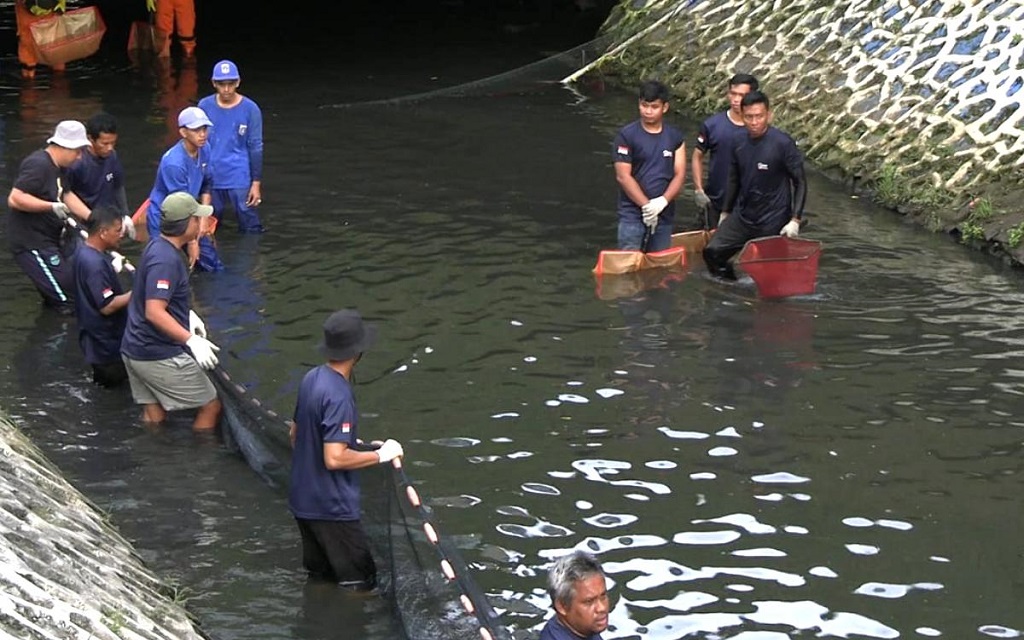
Extermination of plecos in Kali Cideng, Central Jakarta - Source rctiplus.com
Then if we examine it again, perhaps you will ask: "why must they be exterminated, why not just process them?" For the writer this is an interesting question.
Unfortunately, not all invasive alien species are safe for consumption. Perhaps some species could be like tilapia, red devil and some other species that live in clean environments. Some invasive fish, especially those that have high waste tolerance like plecos, are strongly not recommended for consumption. Aksari et al., (2015) reported that the heavy metal content in plecos living in the Ciliwung watershed is very high. This is because plecos live in environments with high waste pollution. Heavy metal content in food has great potential to cause health problems and the most frightening is "cancer". So, actually we could consume them if the environment where the creature lives is free from pollutants, and even premium plecos in some places are processed for consumption. Another alternative that I found is that some species like red devil fish are often processed for livestock feed.
CHAPTER V - EPILOGUE
If we understand the definition of local/native species in the prologue section above, does that mean alien species can become local species? The answer is "no". Indeed, the definition of local/native species is a species that has been part of an ecosystem for a very long time, and not all alien species have the potential to become invasive. However, alien species that have lived for a long time and then become part of the local ecosystem like the black rat previously, cannot be said to be fully local species. They will bear the title of naturalized species. So, no matter how it is, an alien species will not be able to change its nature, but will only shift slightly.
Alien invasion has already claimed many population victims and we cannot fight them with AK-47s or other deadly weapons. But, we can prevent them from coming and causing damage and that is an easier way. Our first weapon is "awareness", namely awareness of ecosystem conservation starting from what is around us. The river next to our house, yard or garden, and the environment around us is not the responsibility of one or two parties but of everyone including you.
Therefore, the writer here emphasizes the importance of "IQRO" or read, examine all decisions before acting. Because often the invasion of an alien species comes from small decisions that appear to have no major impact. The red devil fish, for example, one reason why red devil fish can be in waters and become invasive is deliberate release by irresponsible fish keepers. The reasons could be various, it could be that the fish keeper who can no longer accommodate the fish any longer but is reluctant to let the fish die so it is released into the river. Such things are actually often seen, like someone releasing a cat at the market which actually makes the wild cat population even more explode or Brazilian turtles which we haven't yet mentioned in CHAPTER IV before.
"so releasing a cat at the market is also wrong?"
Perhaps we need to discuss it in the next article, but of course that practice cannot be said to be right. Releasing domestic cats into the wild can cause several problems. What we think is the most humane way considering that there is clearly plenty of food at the market can actually be considered unwise. If we release our domestic cat into the wild, then its reproduction rate will become uncontrolled and can endanger human health, the environment and worse, ecology. Cat feces in places where the population has already exploded can disturb and spread disease to humans and the predatory nature of cats which not only eat rats, but also local birds. Besides that, for cat lovers who want to release their cats, they should reflect on this "if I release my cat at the market, and then it has offspring, then it's not just 1 that I've abandoned but its offspring too". So, if you must release it, make sure the cat is already neutered or sterilized or better yet give it to an animal shelter if there is one.
Finally, there is one more thing the author would like to convey and this comes from one of the YouTube channels called alam semenit. Perhaps you should watch the YouTube channel, and I myself have taken several quotes from it in this article. What the author would like to convey is a brief reflection for all of us, namely, never think that the earth we inhabit was inherited by our ancestors, but rather we are borrowing it, from whom? of course from our children and grandchildren. We are borrowing this earth from our children and grandchildren, and someday we must return it.
That is all from the author, hopefully this article is quite useful and opens the eyes and hearts of many people including myself. The author realizes that this article still has many shortcomings and I myself am not sure whether this article is pleasant enough to read or easy to understand. But with the support from many parties, my spirit in writing has never faded. Therefore, the author greatly expects constructive criticism and suggestions so that they become material for evaluation for future articles. The author says Thank you.
VIVA DIAZ
BIBLIOGRAPHY
Aksari, Y.D., Perwitasari, D. and Butet, N.A., 2015. Kandungan logam berat (Cd, Hg, dan Pb) pada ikan sapu-sapu, Pterygoplichthys pardalis (Castelnau, 1855) di Sungai Ciliwung [Concentration of heavy metals (Cd, Hg, and Pb) of amazon sailfin catfish, Pterygoplichthys pardalis (Castelnau, 1855) in Ciliwung River West Java]. Indonesian Ichthyology Journal. 15(3): 257-266.
Anonymous. 2026. Plecos: The Invasive That Damages Nature and Threatens Our Health. Accessed on 25 September 2026. From digitani.ipb.ac.id
Public Communication and Information Division. 2025. Plant Trees and Distribute Fish Seeds Close the Series of Muskomwil IV – 13 Apeksi. Accessed on: 25 September 2026. From malangkota.go.id
Darwin, C. 1964. On the Origin of Species: A Facsimile of The First Edition. Cambridge: Harvard University.
Hafidz, A.M. and Vallen, F., 2024. Presence of invasive fish Nile Tilapia Oreochromis niloticus (Perciformes: cichlidae) in the Belitung Islands, Indonesia. Journal of River and Lake Aquaculture. 9(1): 1-7.
KSU UMJ Editor. 2024. Advantages and Disadvantages Due to Invasive Fish in Ciliwung River. Accessed on 24 September 2026. From umj.ac.id
Nisrina, N., Islam, M.Y. and Anitasari, N., 2026. Factors of Dominance of Plecos (Pterygoplichthys Sp.) As an Invasive Species: Adaptation and Bioaccumulation of Heavy Metals. Scientific Journal of Student Reasoning and Research. 10(1): 31-54.
Pysek, P., Hulme, P. E., Simberloff, D., Bacher, S., Blackburn, T. M., Carlton, J. T., Dawson, W., Essl, F., Foxcroft, L. C., Genovesi, P. and Jeschke, J. M. 2020. Scientist's Warning on Invasive Alien Species. Biological Reviews. 95(6): 1511 - 1534.
Rahmadi, R. 2026. Red Devil Invades Lake Toba, What is the Fate of Local Fish. Accessed on 25 September 2026. From mongabay.ac.id
Ramadhanu, D., Luhulima, M.Y., Alfian, R.A., Miftahudin, A., Hafidz, A.K., Prananda, M., Putri, S., Aprianto, Y., Nugroho, R.A., Saputra, A. and Sabri, A. 2023. First Record of Invasive Fish Nile Tilapia Oreochromis Niloticus (Perciformes: Cichlidae) on Bangka Island, Indonesia. Journal of Aquatropica Asia. 8(1): 17 – 23.
Saul, W. C., Roy, H. E., Booy, O., Carnevali, L., Chen, H.J., Genovesi, P., Harrower, C. A., Hulme, P. E., Pagad, S., Pergl, J. and Jeschke, J. M. 2017. Assessing Patterns in Introductional Pathways of Alien Species by Linking Major Invasion Data Bases. Journal of Applied Ecology. 54(2): 657 - 669.
Syafei, L.S. and Sudinno, D., 2018. Invasive foreign fish, a challenge to the sustainability of aquatic biodiversity. Journal of Fisheries and Marine Extension. 12(3): 149-165.
Kompas Infographic Team. 2026. Not Easy to Sweep Plecos. Accessed on 24 September 2026. From Kompas.id
Umayanuha, U. M. 2026. Threat of Invasive Species to Aquatic Ecosystems in Brantas River. Accessed on 25 September 2026. From kompasiana.com
Viva DIAZ