
Literature
The Lament of Mother
This language version was translated automatically and has not been reviewed by a human yet.
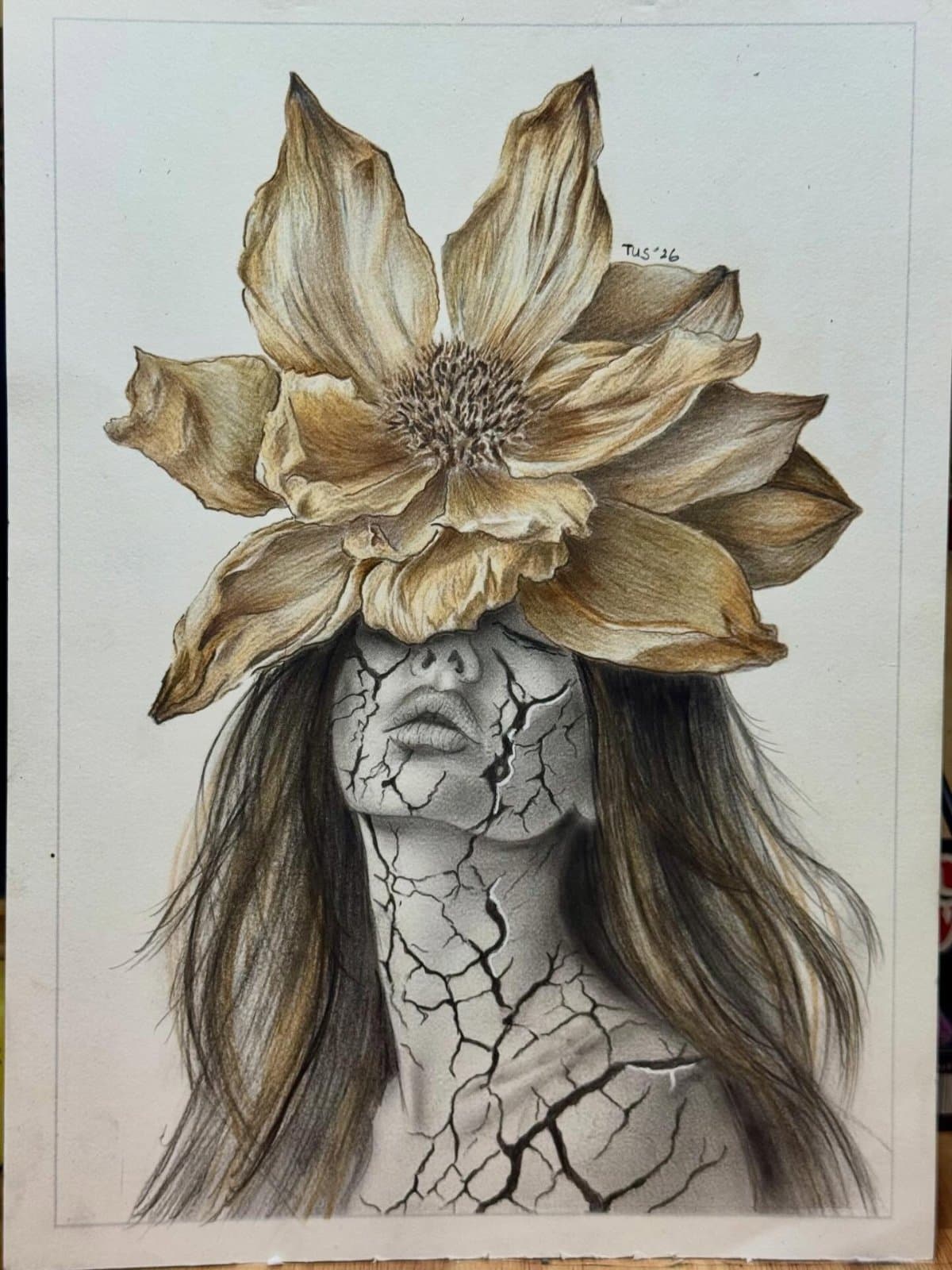
The first part of the Mother Earth Trilogy: a woman's face cracked like parched earth beneath a crown of wilted flowers, etched with charcoal from the remnants of illegal logging in South Malang and coffee stains.
Part 1 of 3 · Mother Earth Trilogy. Continue to part two: Mother's Silent Threshold →
Among the crown of flowers faded to gold, the face of a woman cracks like earth long untouched by rain. This is Mother's Lament, the latest work by Tientus Sudarto — one of DIAZ's Friends — which raises the issue of environmental destruction through a visual language that is silent yet piercing.
The figure depicted is not merely a woman. She is Mother Earth: the womb of life whose beauty is continually embraced and revered, while her body is slowly consumed. The cracks that spread from face to neck are not an outburst of anger, but rather the traces of a civilization that grows by destroying — an exploitation that, in the artist's words, is "intimate".
What makes this work more than mere illustration is the material used to create it. The black color in the cracks is not ink or paint, but charcoal from the remains of wood from illegal logging in South Malang — collected and drawn directly onto paper. The brown color on the flower crown comes from coffee stains. The medium itself becomes part of the issue being discussed: forest destruction is not depicted from the outside, but presented as the raw material of the work itself.
Accompanying this painting, Tientus wrote his poem:
Mother's Lament
It is sorrow that never stops sounding, searching for ears.
The figure of mother in this work is Mother Earth — the womb of life whose beauty is embraced, while her body is slowly consumed.
The cracks on her face are not an outburst of anger, but rather the traces of a civilization that grows by destroying.
An exploitation that is intimate.She cries out in silence.
Because this wound is wrapped in the word progress, celebrated as necessity, and accepted as normalcy. Nature is called beautiful, yet treated as something that can be exhausted.
The lament settles as a silent pain — when destruction no longer feels cruel, because it has become ordinary.Is it right?
That closing question — "Is it right?" — is the heart of the entire work. It is not posed as an answer, but as a pause: an invitation to stop for a moment and question what we have long accepted as normal, when environmental destruction becomes an ordinary backdrop to witness.
Mother's Lament is presented as part of DIAZ's Friends' contribution to documenting voices that respond to environmental issues from various media — this time, through hand-drawn marks on paper.
Work Specifications
- Media: Charcoal and coffee stain on A4 natural paper.
- Black color: charcoal from the remains of wood from illegal logging, South Malang.
- Brown color: coffee stains.
Mother Earth Trilogy
Three works by Tientus Sudarto read in sequence, from lament, to silence, to remnants:
- Mother's Lament — a wound still searching for ears (this section)
- Mother's Silent Threshold — a wound that chooses silence
- Mother, in the Remnants — a wound that leaves almost nothing left to be heard at all
- Sahabat DIAZ
- Seni Rupa
- Puisi
- Lingkungan
- Ibu Bumi
- Trilogi Ibu Bumi
Viva DIAZ