
Keilmuan
TALES OF THE EAGLES: MASTERS OF THE ANCIENT SKY
This language version was translated automatically and has not been reviewed by a human yet.
Tales of the Eagles is a collection of articles that discusses eagle species wrapped in a writing style with elements such as folklore or storytelling while not abandoning scientific elements.
Hello Commander/Sister VIVA DIAZ !!!
In the previous article, we already discussed the meaning or significance of the name DIAZ in this nature-loving organization (read >> From European Explorers to Ancient Eagles). In it, we already included profiles of a European explorer figure and ancient eagles as well as the flying reptile Pteranodon. Perhaps for those who don't know yet, you can read it first, to make it more fun hehe...
Tales of the Eagles is a collection of articles discussing eagle species wrapped in a writing style with flavors such as folklore or stories but without leaving out scientific elements.
It should be noted that writing articles may never be completed without support from colleagues who have provided their support both in moral form and in literature searches. For this reason, we extend our gratitude to:
General Chairman of OPA DIAZ Redy Apriyadi - D. 139140 Elang Borneo
General Board of OPA DIAZ
Yoga Ahmad Alauddin - D. 139.2024.33.12 Elang Bondol
Hamim Mustofa / Topeng - D. 13994 Elang Ular
Hamim Tohari / Komandan - D. 13960 Elang Jawa
Nabila Quratu'aini Khairunnisa / Jaenab - D. 139178 Elang Bondol
Sabda Gemaning Azhar / Megantropus - NA. XVII.24.077.ASP (MAPALA ASPAL Institut Asia Malang)
Betafonda Ramadhan Cahya / Pluto - XXIV-134/KE/24 (MPA Kepak Elang Universitas Bhineka Nusantara Malang)
Entire OPA DIAZ Family
Entire MAPALA ASPAL Institut Asia Malang Family
Entire MPA Kepak Elang Universitas Bhineka Nusantara Malang Family
Besides that, we have great hopes regarding constructive criticism and suggestions that can serve as material for evaluation in future writings. So that subsequent writing can be even better and increasingly build this blog.
PROLOGUE
"The eagle flies high as if without limits. It roams the world in independence. It is rarely visible and rarely heard. It is not a group of noisy songbirds..."
-Galileo Galilei in The Assayer-
Long before we (humans, Homo sapiens) set foot on earth, the earth was dominated by various forms of life, on land, sea and also sky. Life that was very different, primitive or even strange yet beautiful to study for some of us. For millions of years, vast lakes and swamps spread across open plains covered with tall grasses or ancient deciduous forests, and ceaseless tectonic plate activity shaped towering mountains. These different environmental conditions created unique challenges for creatures living within them, so unique and strange life for us emerged as a response to the environment, adaptation and evolution that took place over a very long time.
In our previous discussion, we have learned that there was a flying reptile Pteranodon that lived in the Mesozoic Era precisely in the Late Cretaceous Period around 86 - 84.5 million years ago. Although this creature has no kinship relationship with any species now, scientists believe that Pteranodon is the distant ancestor of birds as well as crocodiles and alligators. Different environmental conditions, climate change, disasters and natural selection supported the occurrence of evolution and even extinction that caused the emergence of new forms of life in the subsequent era.
The oldest ancient eagle ever found is estimated to have lived in the Cenozoic Era precisely in the late Oligocene period around 25 million years ago, long after the last Pteranodon lived and the first modern human (Homo sapiens) appeared. Archaehierax sylvestris is a bird believed to be the oldest eagle and lived in the dense forests of ancient Australia. But before going too far, perhaps it would be good for us to first get to know the eagle itself.
The eagle is one of the important groups in the family Accipitridae under the order Accipitriformes. Besides eagles, other birds such as sparrowhawks, harriers, buteos and Old World vultures are also part of this family. Eagles themselves are not included in a single genus but are spread across several different genera with classifications that vary based on sources of reference from ongoing research. Bird genera such as Aquila, Haliaeetus, Spizaetus, Harpia, Circus, and Ictinaetus are the main genera that include eagles, while other genera such as Pithecophaga, Polemaetus and Gyps are also classified as eagles. In a broader sense, the eagle is an active predatory bird of the family Accipitridae that has characteristics of large to medium size, has a strong, curved, and sharp beak for tearing prey flesh and a more adaptive habitat so it can be found in forest areas, grasslands, mountains and also coastal areas. In another sense, the eagle itself sometimes has subjective characteristics and may have different meanings in some regions.
ANCIENT FOREST EAGLE - Archaehierax Sylvestris
Approximately 25 million years ago in the Cenozoic Era, specifically in the late Oligocene period in Australia, amid an ancient landscape full of mystery and natural power, a group of formidable predators had dominated the airspace. Archaehierax sylvestris, the oldest eagle species ever discovered. With sharp eyes and unmatched power, they held the role as apex predators.

Archaehierax sylvestris
Source: bbc.com
Archaehierax sylvestris literally means "Ancient Forest Eagle". It is not without reason that it is named this way, because Archaehierax sylvestris inhabited the dense forests of Australia. This eagle had adapted to be an active hunter and fly within forests with the presence of short, strong wings and long legs with a wide span.
The fossil of this eagle was first discovered in 2016 by a team of scientists from the Center for Evolution Research and Biogeography Biology at Flinders University Australia or the Vertebrate Paleontology Group led by Dr. Ellen Mather. They found it in the prehistoric sediments of Lake Pinpa, South Australia, which area was previously estimated to be a dense forest. This fossil is the most complete eagle fossil ever found and recorded from the Oligocene period in the world, consisting of 63 bones, and considering its role as an apex predator, it must have had a small number of individuals. After its discovery, this fossil was then studied and classified as a new species with the name Archaehierax sylvestris, and its formal description and research results were only published in 2022 in the journal Historical Biology.

Discovery of 63 bone fossil Archaehierax sylvestris by the Paleontology expert team from Flinders University
Source: bbc.com
Perhaps some of us would think that "Ancient Eagle" or something from the old world has extraordinarily large size. Perhaps it has been embedded in our minds like that, like some "meme" videos "slowly sir driver, slowly sir driver" 😂.
For some creatures, especially those from the Carboniferous era or around 359 - 299 million years ago, there may be some truth to it. However, not everything from the ancient world is large, an example is Archaehierax sylvestris itself.
Based on its fossil, Archaehierax sylvestris has the characteristic of short wings. This creature had evolved to live in a dense forest environment, certainly having wide wings could restrict movement and make flying maneuvers difficult between trees. Even when compared with modern eagles such as Aquila audax or better known as the Wedge-tailed Eagle which is the largest eagle in Australia today, Archaehierax sylvestris has a posture that tends to be smaller.

Comparison of Tarsometatarsus leg bones from Archaehierax sylvestris (left) and Aquila audax (right)
Nevertheless, Archaehierax sylvestris is still believed to be the ruler of the sky, in other words as an apex predator. Experts believe that this creature was likely an opportunistic predator that hunted small to medium-sized animals such as mammals, reptiles and birds as well as other small animals available in its forest habitat. Furthermore, with the estimated posture of its wings, it is possible that Archaehierax sylvestris was a slow flyer more suited to hunting tactics in the forest. They were ambush hunters that waited for prey from their perching place and then swooped in to attack.
Much is still unknown about this Ancient Eagle, both in terms of its reproduction patterns, whether its social behavior was solitary like modern eagles or rather in groups, as well as its lifespan. However, from existing speculation, Archaehierax sylvestris had a lifespan like modern eagles of similar size, namely 20 - 30 years, and life activity that is estimated to be a diurnal creature or active during the day.
TRUE EAGLES AQUILA - Aquila nipaloides and Aquila bivia
If previously I said that eagles do not occupy a single genus but are divided into several genera under the family Accipitridae, the genus Aquila is a genus that contains specifically eagle species. The name Aquila itself can be interpreted as Eagle and is known as "True Eagle". It is possible that the name Aquila comes from the term Aquilus which means "that which is dark in color".
Unlike Archaehierax, Aquila is still alive to this day with several of its species in the world. The Aquila eagles that are still alive today include Aquila chrysaetos (golden eagle), Aquila nipalensis (steppe eagle) and Aquila heliaca (imperial eagle). However, there are 2 species among them that are also among the oldest eagles ever found as fossils, although unfortunately we can no longer see them. These two species are Aquila nipaloides and Aquila bivia.
Aquila nipaloides
In ancient times, on a vast grassland or forested area in Europe and Asia, an eagle once reigned as the master of the sky. With a wingspan almost as long as the height of a modern adult, it seemed to display its power and might as a sky predator. It circled through the air like a fighter reconnaissance aircraft on a battlefield that became a terrifying specter for enemy infantry soldiers. Then, after the prey target was found, it seemed to report like a fighter pilot and say "target supported", then maneuvered into a dive like the German Junkers Ju 87 or Stuka aircraft during World War II about to drop bombs. "STRIKE !!!". After that, the prey, which was a rodent, was successfully caught. This eagle's scientific name is Aquila nipaloides.
.jfif)
Junkers Ju 87 or Stuka German dive bomber aircraft bombing Allied forces in WWII
Source : thisdayinaviation.com
Aquila nipaloides is an ancient eagle estimated to have lived during the Middle Miocene Period around 15 million years ago and some other research mentions the possibility that this eagle lived until the Pliocene Period around 2.3 - 5.3 million years ago. Based on fossil findings, this eagle lived in Europe and Asia so it can also be concluded that its habitat was likely in forested areas and open plains such as grasslands or steppes.
This eagle has similar characteristics to its living relative, Aquila nipalensis or Steppe Eagle, which has led scientists to frequently make comparisons between the two to find clues about the characteristics of A. nipaloides including reproduction, hunting patterns, lifespan and other characteristics in the past. In fact, A. nipaloides is often referred to as Steppe Eagle in Internet searches. However, beyond that, based on this approach, A. nipaloides likely hunted like the story above, namely by flying in orbits to detect prey and then catching it with a diving or swooping motion downward like the Steppe Eagle. Rodents, small mammals, or other birds are estimated to be the main prey of A. nipaloides.

Aquila nipalensis (Modern Steppe Eagle)
Source : observation.org
To date, experts have not been able to provide certainty about the exact size of this eagle because all information is based on estimates from fossil findings. However, experts believe from its fossil findings that A. nipaloides likely had a body shape and weight almost the same as the modern steppe eagle or even larger. The Steppe Eagle or Aquila nipalensis has a body length of 62 - 81 cm and a wingspan of 165 - 200 cm or even reaching 262 cm in females with a weight of 2 - 3.5 kg and 2.3 - 4.9 kg in females. With its size, A. nipaloides can be said to be large, where if compared with the average height of humans in Indonesia, this eagle almost reaches half a body height and its wingspan is almost the same as human height. Likewise its weight, it might be almost the same or even heavier when compared with the weight of zakat fitrah rice which is only 2.5 kg or an empty 3 kg melon LPG cylinder.
Aquila bivia
In another region of the earth in a younger era, on the edge of forests in the American continent, an eagle chose a clever tactic. Guerrilla tactics are combat tactics that might be most suitable when compared with this eagle's hunting tactics. It waited patiently from a height but was quick upon seeing prey passing by, almost similar to guerrilla combat tactics where soldiers are positioned hidden in higher areas to carry out sabotage. No need to be seen, but the enemy knows who they should fear.
Aquila bivia first lived in the early Pleistocene era approximately 1.7 - 1.6 million years ago. Fossils of this eagle were found at only two distant locations, namely Inglis 1A, Citrus, Florida and 111 Ranch, Graham, Arizona, United States. Because of this, the eagle was named "Bivia" in Latin meaning two directions, referring to its fossil distribution across 2 distant locations. Based on the geographical conditions of the environment where the fossils were found, it is estimated that A. bivia lived in a more open habitat than A. nipaloensis — open or semi-open areas such as grasslands, steppes, or forest edges with hilly terrain.
.png)
Fossil Bone Findings of Aquila bivia at Inglis 1A and 111 Ranch
Source: Florida Museum of Natural History
Almost similar to A. nipaloides, experts also frequently use an approach method with its living relatives to estimate its characteristics, namely with the Golden Eagle or Aquila chrysaetos. Experts suspect that A. bivia's hunting method was by waiting from a high place such as a large rock or trees and then ambushing its prey with a swift attack from the air, similar to modern golden eagles. Its prey is estimated to be small to medium-sized animals such as four-legged mammals, large birds, or reptiles.

Aquila chrysaetos (Modern Golden Eagle)
Source: ebird.org
A. bivia also had a larger body than A. nipaloides and is estimated to be 10 - 15% larger than the Golden Eagle, with a body length of approximately 77 – 104 cm. If we compare it again with the average height of an adult person in Indonesia, this eagle when standing could reach up to the abdomen or chest of a human. Moreover, with its wingspan ranging from 198–276 cm, it is far wider than the height of a human, and could even reach more than one and a half times the height of a human. Similarly with its weight, A. bivia's weight is estimated to reach 3 - 6 kg, almost approaching the weight of a full LPG melon canister which is 8 kg.
THE SILENT MAHARAJA OF THE ARCHIPELAGO - Spilornis robustus
The Archipelago with its tropical regions covered in forests with high tectonic activity and areas that are rich and fertile. A group of eagles, becoming the masters of the sky who reign and sit above the glitter of green emerald precious stones. They were rulers before the tales of heroism by the kings we know from school history books. Although their stories are not well recorded, their tales still echo like a lullaby.
Until this article was written, it is very unfortunate that information regarding Spilornis robustus is extremely scarce. I myself have not found a single scientific reference specific to this eagle species, but rather general scientific knowledge sources available on the internet. Even when I tried to use AI to help find sources, the AI only answered with very little information along with labels such as "not found in search results".
However, from the limited information available, it is said that the Spilornis robustus eagle was an eagle that lived in the Early Pleistocene approximately 1.8 million - 800 thousand years ago. Fossils of this eagle were found in several areas on the island of Java, Indonesia. From these fossil findings, it is suspected that Spilornis robustus inhabited open areas and forests of Java island.
Actually, there are still living relatives of this eagle from members of the genus Spilornis and scattered in several areas in Asia, starting from West India, Nepal and continuing eastward to China, then southward across Southeast Asia, the Malay Peninsula, the Greater Sunda Islands to Palawan Philippines. The living members of the genus Spilornis are the Crested Serpent-Eagle or Spilornis cheela. However, S. robustus is estimated to have been larger than its relatives although its exact size is unknown. Besides that, its diet is also estimated to have possibly consisted of snakes, lizards, birds, and small mammals, like its living relatives. However, because of its larger size, it may have also preyed on larger animals.

Crested Serpent-Eagle or Spilornis cheela
Source: id.wikipedia.org
The extinction of this eagle also cannot be determined with certainty, experts suspect its extinction may have been due to several causes. Some of these include climate change, habitat loss, or competition with other species. In other words, its extinction was most likely caused by a reduction in food sources, which could have been caused by the factors mentioned.
THE MIGHTY GAFFE EAGLE - Dynantoaetus gaffae
Going back to the Australian continent, around 700,000 - 50,000 years ago during the Pleistocene Period, there lived a giant and the largest eagle that ever existed on that continent. This eagle perhaps seemed to be a symbol of sky power or air supremacy in its time. Its name was Dynantoaetus gaffae. The name Dynantoaetus itself is taken from the Latin "dynatós" which means mighty or strong and "āetós" means eagle, while gaffae is the name of an expert Priscilla Gaff as the first to discuss this eagle fossil in her thesis.
The Gaffe Eagle had an extraordinary size and was the largest apex predator of its time and perhaps even until now. The wingspan of the Gaffe Eagle could reach 3 meters with its very strong and long talons up to 30 cm, estimated to be able to grasp a kangaroo. Yes, you are not misreading or reading too quickly, they were quite capable of attacking a "kangaroo".
_(8079586639).jpg)
Aquila audax (Modern Wedge-tailed Eagle) Source : id.wikiedia.org
Previously, to try to compare, have you ever seen a kangaroo in Australia?, or have you ever seen a video at the link below?.
Watch >>> A Kangaroo Gets a "Sports Greeting" From a Man in Australia
The video contains an unfortunate dog that was caught by an adult kangaroo. Look carefully at the muscles of its body, isn't that kangaroo like a model from GYM posters?. Although in the end the kangaroo retreated after being hit by the dog owner who was like Muhammad Ali in the ring, but look at its height, the kangaroo was almost as tall as an adult human.
Besides kangaroos, the Gaffe Eagle is also estimated to have preyed on giant flightless birds such as Moa birds and other megafauna that existed in Australia at that time. Much is still unknown about the hunting tactics of this eagle. However, with that large body posture, it was possible for the Gaffe Eagle to hunt large creatures and carry them in flight.

Illustration by an artist depicting the giant Australian eagle able to attack a Moa bird
Source : nationalgeographic.grid.id
Fossils of this eagle were found in several places by researchers and cave explorers or "Cavers" from Flinders University Australia, namely Naracoorte Cave, Wellington Cave, near Cooper Creek in the Lake Eyre Basin and Mairs Cave in the Flinders Ranges, South Australia. The experts then combined the fossil remains they found from various points. "After half a century, and several delays caused by the pandemic, an expedition with volunteers from the University Speleology Society found 28 more bones scattered among the rocks at the location indicated by one of these museum artifacts. We were very pleased to find more bones from most of the skeleton to create a better picture and description of these long-lost giant birds" said Dr. Ellen Mather (in news.flinders.edu.au). Based on these fossil findings as well, it is also estimated that the habitat of the Gaffe Eagle which may have once lived in forest and riverside areas throughout eastern Australia.

Paleontologists and Cavers from Flinders University descend into caves in the Flinders Ranges to find the remains of the giant eagle. Photo: Aaron Camens
Source : news.flinders.edu.au

Efforts to retrieve bones among the rocky floor of Mairs Cave, Flinders Ranges. Photo: Aaron Camens - Source : news.flinders.edu.au
Besides that, from its fossil findings, experts were also able to estimate its body size. As mentioned above previously, the wingspan of Elang Gaffae was as wide as 3 meters and that was certainly far greater than the height of an adult human in Indonesia. Its body weight ranged from 12-18 kg which is even equal to or even heavier than your carrier bag when climbing a mountain. Although there is no certain information regarding its body height, it is estimated that this eagle was 2 times larger than Elang Ekor Baji which is the largest eagle in modern times, and from these 2 variables it has shown us that Elang Gaffae is truly a mighty eagle.
.webp)
The first fossil remains of Dynatoaetus gaffae were collected from Mairs Cave in Flinders Ranges Source : nationalgeographic.grid.id

Comparison of tarsometatarsus bone (leg bone) of Dynatoaetus gaffae and Elang Ekor Baji, with estimated silhouette of living animals above. Graphic by Ellen Mather (Flinders University) - Source : news.flinders.edu.au
Although Elang Gaffae is called an Eagle, they actually have close taxonomic kinship with old world vultures such as vultures found in Africa and Asia. However, besides vultures, their taxonomy is also close to the nearly extinct monkey-eating eagle from the Philippines, namely Elang Filipina or Pithecophaga jefferyi.

Elang Filipina or Monkey-Eating Eagle (Pithecophaga jefferyi) attacking a primate
Source : youtube.com
GIANT EAGLE FROM CUBA - Gigantohierax suarezi and Gigantohierax itchei
In the ancient sky of Cuba, above dense forests and vast savannas, soared Gigantohierax suarezi, the unrivaled master of Cuba's skies. With a towering wingspan, it carved a path among the clouds, its sharp eyes observing the land below. Every movement was a manifestation of power and elegance, a symbol of dominance in a wild and merciless world. It was the apex predator, a living legend whose existence struck fear into the hearts of all creatures beneath it.
Along with it, flew Gigantohierax itchei, a loyal sibling and agile hunter. Although smaller in size, it possessed unmatched speed and agility, complementing its sibling's raw power with deadly precision. Together, they formed an unstoppable partnership, hunting side by side, sharing the spoils of victory, and ensuring the continuation of their lineage in an ever-changing world. They were Gigantohierax, the giant eagles of Cuba, and their story is carved in the wind and stone, an eternal testament to the grandeur that once existed.
.jpg)
Illustration of giant eagle Gigantohierax by Hodari Nundu an animator artist
Source : birdnote.org
Gigantohierax is a genus name that encompasses 2 species, namely G. suarezi and G. itchei. Although it cannot be determined with certainty whether there was interaction between these 2 species, they are believed to have lived in the same era and even side by side. This eagle is estimated to have existed during the Quaternary Period approximately 1 - 0.1 million years ago.
Both G. suarezi and G. itchei were very large birds. G. suarezi was one of the largest Accipitrida (family of raptors) that ever existed in the Americas and even far larger than the modern harpy eagle (Harpia harpyja) which is currently the largest eagle on the continent. Gigantohierax may have had a total length of more than 30 cm (12 inches) and is estimated to have been 40-50% heavier than the harpy eagle. Meanwhile G. itchei was approximately 29% smaller than G. suarezi.

Modern harpy eagle (Harpia harpyja) has a body almost as large as an adult human - Source: tagar.id
Fossils from G. suarezi are the first discovered, namely in cave deposits in Cuba which were then first described in 2002 by Arredondo and Arredondo. The second species is G. itchei which was first described in 2020 by William Suarez based on fossil findings in the tar seepage of Las Breas de San Felipe, Cuba.
Their name is taken from the word "giganto" which means giant or very large and "hierax" which means bird of prey. The species name "suarezi" is taken from the name William Suárez, a Cuban paleontologist who also described the species Gigantohierax itchei in 2020. As for the species "itchei" it may also refer to the place where the fossil was found or the expert who discovered it, in other words there is still not enough information to know the meaning of the word.
Until now, experts have still not been able to conclude what prey they hunted. However, Cuba during the Pleistocene era was inhabited by various types of mammals such as giant ground sloths, large rodents, and primates, it is possible that Gigantohierax preyed on them. Including the illustration above previously depicted Gigantohierax about to prey on a mammal, namely a Caribbean monk seal pup. Besides that, other animals such as smaller-sized birds and reptiles such as crocodiles and large lizards that lived in that era may also have been its prey. As for sources that say that, carrion was also a source of food for them especially when they had difficulty finding live prey.
KING OF THE SKIES OF ANCIENT HAWAII- Haliaeetus sp.
In ancient times, when the mighty Hawaiian volcanoes had spewed hot lava with oceans stretching around them, a top predator king watched from the heights of the island archipelago. He was Haliaeetus a distant relative of the bald eagle that now reigns in the skies of Eurasia and Alaska.
His life began more than 100,000 years ago or around the end of the Pleistocene Age. His body was more powerful than his living relatives, perhaps he was the largest of all his relatives. The Ancient Hawaiian Eagle had a wingspan of approximately 1.78 - 2.45 m which it used to traverse the expanse of forests and open plains on the islands of O'ahu, Moloka'i and Maui. Although to this day there is no record of how or where the king lived and nested, it is believed that he explored various corners of the archipelago from the mainland in the middle to near the shoreline.
A 2015 study mentions fossils of an ancient eagle in Maui that is 3,500 years old. The study also showed that this eagle had a different lineage from its relatives including Haliaeetus albicilla or Bald Eagle. Thus, the assumption to this day, although its species has not yet been described, it is possible that this eagle is a new species found from the genus Haliaeetus.

Haliaeetus albicilla (Bald Eagle)
Source: e-bird.org
Its body itself is estimated to have weighed approximately 3.1 - 6.9 kg with a length of 66 - 94 cm which also made it the largest predator of its time. The prey of this eagle was probably small mammals and flightless birds that lived at that time in Hawaii. For years, the Ancient Hawaiian Eagle lived isolated there until it became an inseparable part of ancient Hawaiian nature as a guardian of the ecosystem.
However, we already understand very well that nature is something dynamic. It changes slowly and gradually and its changes are followed by everything that lives within it. As for the presence of humans with their increasingly massive activities, it disturbed the ecosystem and reduced food sources. In the end, before the year 1500 AD, the Hawaiian eagle king disappeared from the sky and was never seen again.
HAAST'S EAGLE THE FLYING TIGER - Hieraaetus moorei
Have you ever watched the film The Lord of The Rings or The Hobbits?. Do you remember the scene when the eagles saved the dwarves led by Thorin Oakenshield along with Bilbo and Gandalf from the pursuit of wargs and orcs led by Azog the Defiler by carrying them flying to a safer place in The Hobbit: An Unexpected Journey (2012)?. Or the scene when the eagles saved Frodo and Sam from the eruption of Mount Doom in Mordor after successfully destroying Sauron's ring?.
The eagles mentioned in the film are called The Eagles where they are protagonist creatures that side with the Valar and Maiar as well as the races of elves, dwarves and humans who are loyal. They are told to have helped the human-dwarf-elf alliance fight darkness in many battles in Middle Earth. Among those written in the novel, the largest and most powerful is the king of the eagles himself named The King of Eagles "Thorondor".

The King of Eagles Thorondor (right) and Gandalf The Grey or Mithrandir (Left)
However, of course in the real world there is no bird that large capable of being ridden by a wizard like Gandalf in the story or even a Hobbit. Until now, the record holder for the largest eagle is Hieraaetus moorei or also called Haast's Eagle from New Zealand. The natural conditions and environment in New Zealand at that time were factors that made it a giant eagle.
Back to the main topic ...
In ancient times, when human civilization was still newly developing, there lived a legend, a true eagle king with extraordinary size. He was the largest of many species categorized as eagles to this day. When he flew, the span of his wings alone was capable of shaking the heart of anyone who saw it until they ran in fear. He was Haast's Eagle, the master of the ancient skies of New Zealand.
Based on the latest research, Haast's Eagle lived around the late Pleistocene Period to the early Holocene Period and became extinct around 1400 AD. Most of its fossils were found on the South Island of New Zealand with its initial discovery at Glenmark Estate, Canterbury, South Island and became the most significant discovery made. These fossils were generally found in that area especially in caves, swamps, and other natural traps.

Illustration of Haast's Eagle (Hieraaetus moorei)
Source: nationalgeographic.grid.id
Based on the fossils collected, it is estimated that Haast's Eagle weighed approximately 13 - 18 kg, almost or even heavier than your carrier when climbing a mountain. Its wingspan was about 2 - 3 m, which means longer than the average height of a human body in Indonesia. The thing that makes this creature also called a flying tiger is because of its talons that reached a length of 9 cm, where this figure is almost the same as when I tried to measure my index finger.
.jfif)
Comparison of physical size between Haast's Eagle, human and harrier
Source: prehistoric-wildlife.com
Scientists believe that, given the natural conditions of New Zealand at that time, the Moa bird was its primary prey. The Moa bird is a giant flightless bird estimated to have weighed up to 230 kg, and Haast's Eagle is believed to be the actor behind the balance of the Moa population at that time. Besides Moa, several other creatures of medium to large size such as birds or other land animals were also prey of Haast's Eagle. Even in some opinions of scientists, humans were also a healthy prey for this eagle.
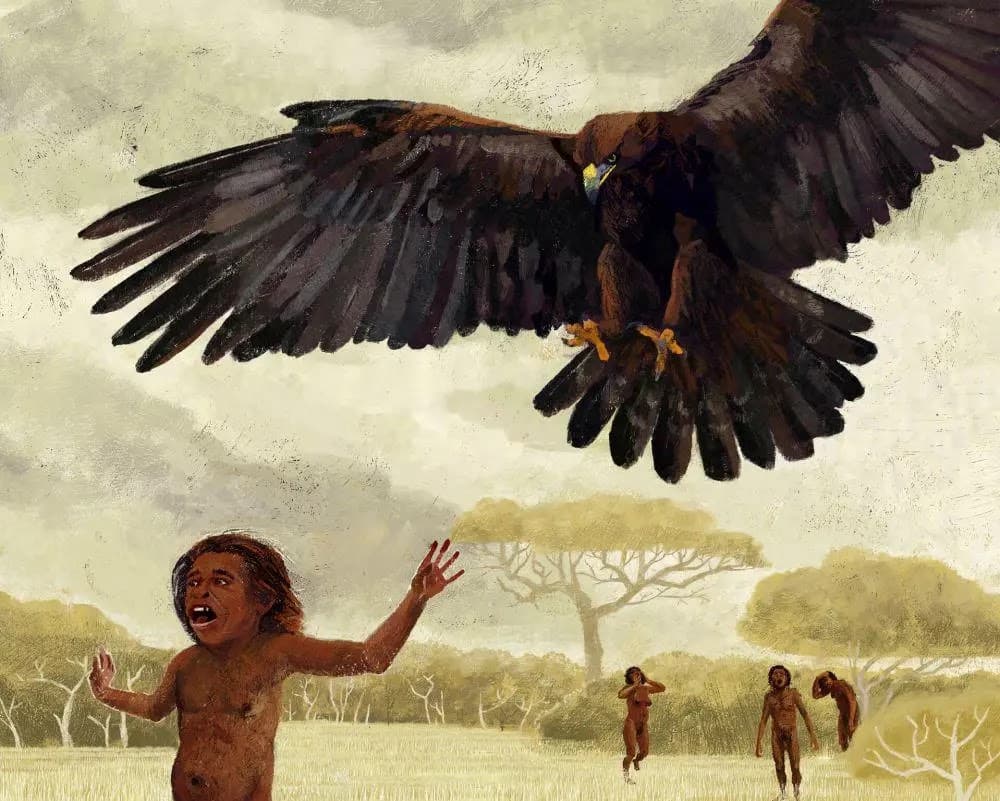
Some sources say that Haast's Eagle has a connection with the legend or mythology of the Maori tribe, who are the indigenous people of New Zealand. Far different from our previous comparison with the eagles in the Lord of The Rings or The Hobbit films which are protagonist creatures, in the Maori tribe legend Pouakai or Hokioi is depicted as somewhat more fierce. Pouakai or Hokioi is a mythological creature in the form of a giant bird that often kidnaps or preys on humans, both children and adults.

Illustration of the Pouakai or Hokioi creature in Maori tribe mythology
Source: idntimes.com
Paul Scofield in smitsonianmag.com, a researcher in the study of Haast's Eagle, agrees that Pouakai or Hokioi is real. He said that "This science supports Maori mythology about the legendary pouakai or hokioi, a large bird that could swoop down on people in the mountains and was capable of killing a small child. They had the ability not only to attack with their talons but also to close their talons and pierce objects that are quite hard like the pelvis. The bird was designed as a killing machine," he told independent.
Although legends say that Haast's Eagle had the behavior of abducting or flying away with its prey, it does seem somewhat plausible, especially since Haast's Eagle holds the record as the largest eagle. However, this has remained a hotly debated topic among scientists to this day. Even the most powerful modern eagles, such as the Golden Eagle (Aquila chrysaetos), are usually only able to carry prey weighing no more than half their own body weight. Haast's Eagle, weighing 10-18 kg, most likely could only carry prey that was much smaller. The Moa bird, which had a larger weight, when using the comparison with the Golden Eagle, Haast's Eagle would still not be able to carry it. So most likely Haast's Eagle hunted by striking its prey, or if there was still a possibility that it truly abducted prey, then the size of its prey was small, less than half its body weight.
However, like the stories of the sky-ruling eagles before it, it cannot be denied that nature is indeed something that can change rapidly. Humans are also still the main actors in this rapid change. It is stated in several sources that Haast's Eagle became extinct not long after the arrival of humans, namely the Maori people. Food competition, habitat destruction, and hunting by the arriving humans are considered the most plausible factors.
The Moa bird, which was previously the main prey of Haast's Eagle, also began to be hunted by humans. The increasing human population made them more aggressive in opening new lands, so Haast's Eagle's space for movement became increasingly narrow. And indeed, human instinct about the existence of predator threats made Haast's Eagle considered a competitor both in food availability and territorial control, so it also began to be hunted. This continued until Haast's Eagle, or the Flying Tiger, began to disappear from the skies of New Zealand around 1400-1500 AD.
EPILOGUE
Someone once told me during a conversation at the OPA DIAZ Secretariat about what the spirits of eagles are like, one of which roughly might be like "Some birds talk (chirp) too much". Eagles are indeed not songbirds like parrots or thrushes, let alone those kept in small cages as entertainment for their owners. Although there are indeed eagles that are caged, perhaps by irresponsible people or for conservation purposes in captive breeding, but whoever it is and whatever the eagle is, everyone will acknowledge that eagles are remarkable birds with their own definitions. Eagles are also not creatures that bring crowds to display their power. They are solitary birds, yet enough to keep their prey always alert.
Perhaps we need to follow this kind of behavior from eagles. Just as the Javanese philosophy says that the more rice is filled the more it bows, perhaps this is nature's way of reminding us. Sometimes we see people who often show off their abilities excessively, while more competent people tend to appear calm and never feel satisfied with their expertise. The more someone describes their "self" to others, the longer it will seem like a bird entertaining its owner from within a cage that limits its movement. That cage is like the satisfaction of receiving knowledge and then being busy chirping.
In a book I once read titled Atomic Habits by James Clear, identity is indeed something we must first have to achieve satisfying results more efficiently to change bad behavior into good behavior, but those results are obtained through processes that will later become evidence of our identity. So, our identity is not proven by mere chirping but by processes that are built continuously and consistently.
However, arrogance may indeed be one of the negative traits of humans that has clung to us for a very long time. I am not trying to make arrogance a normal thing to do (please note). However, we are indeed too arrogant, and we are the only creature on earth that names other creatures as we please and then names ourselves with a grand name, namely "Homo sapiens" which means Wise Man. As if we forgot what humans have done on earth since its existence.
How much have we destroyed, what have we demolished, or what have we eliminated and erased the existence of because of our existence as wise humans? The Ancient Hawaiian Eagle (Haliaeetus sp) and Haast's Eagle (Hieraaetus moorei) and several other animals whose stories are not told here are evidence that such powerful rulers were displaced and destroyed by our existence. However, the remnants of their past glory never fade, their stories remain as evidence of the dark history of civilization to always remind us as wise humans who should care for, not destroy.
For now, perhaps that is all the stories of the ancient eagles that we can present. From our research above, we hope to add insight for both readers and writers. In your opinion, what is the definition of an eagle or the spirit of an eagle that we can apply? And what should we do in this era after reading this article to care for and preserve the life that exists? Write your opinions, criticisms, and suggestions in the comments section.
That's all from us - VIVA DIAZ !!!
Viva DIAZ